Sunday, January 1, 2012

India will allow individual foreign investors direct access to its stock market from January 15, the government said on Sunday, the latest step to liberalise Asia's third-largest economy after a year of big losses on the benchmark Sensex index.


Previously, foreign nationals were limited to investing in India's equity market through indirect routes such as mutual funds, or through institutional vehicles.
"The central government has decided to allow qualified foreign investors to directly invest in (the) Indian equity market in order to widen the class of investors, attract more foreign funds, and reduce market volatility," the government said in a statement.
In the past 20 years India has gradually opened its economy to foreign cash. The economy is now faltering after growing at an annual average of about 8 percent for several years.
The rupee shed 24 percent of its value against the dollar last year and the current account deficit is widening.
Many economists predict growth below seven percent for the fiscal year that ends on March 30.
Indian shares posted their first annual fall in three years in 2011 as a combination of near double-digit inflation, high interest rates, slowing domestic growth and policy inaction turned off investors already shaken by global headwinds.
Foreign fund inflows, a major driver of Indian stocks, dried up with net outflows of about $380 million as of Wednesday, a far cry from record inflows of more than $29 billion in 2010 that had powered a 17 percent rise in the benchmark index, following an 81 percent surge in 2009.

Shipping companies sense an opportunity in crisis


The shipping industry may be going through a tough period, but some companies are sensing an opportunity in it. With ship prices declining by over 65 per cent, they are seeing it as a great chance of acquiring assets at a cheaper price. For instance, a 10-year-old very large crude carrier (VLCC), which was earlier sold for $75-80 million, is now available for $23-25 million.
“We are keeping our eyes and ears open for any opportunity that may arise. Globally, there are distress sales happening since the fall in trade has taken a toll on shipping companies,” said A R Ramakrishnan, managing director of Essar Shipping.

Though companies bleeding like the Shipping Corporation of India have put on hold their expansion plans, it’s the best time for those with deep pockets to expand. According to experts, the best time to expand is when prices are down and one can see some light at the end of the tunnel in terms of trade picking up.

“The general sense is markets can go down further and one does not want to be stuck with an asset. But it’s an opportunity one has to keep a close watch on,” said a senior member of the Indian National Shipowners’ Association.
Apart from VLCC, prices in other categories like product carriers and dry bulk carriers have also nosedived.

“Due to the steady oversupply and prolonged weakness in freight rates, asset prices across all segments have fallen substantially, more due to resale than new buildings. Resale values fell from the peak levels of 2008 to 40-60 per cent, depending on the asset size and age, while new building prices fell 30-50 per cent from the highs of 2008,” a Great Eastern Shipping spokesperson said.

With the current glut situation in markets, experts say this is the best time to consolidate and put the best practices in place. “Shipping companies have space to focus on things like safety issues, which they don’t have in boom time. There is an opportunity in every crisis. Also, India’s Exim trade won’t be impacted in a bad way,” said Satish B Agnihotri, director general of shipping.


He said the time was ripe for companies to look for acquisitions. “India is better placed compared to other countries in this crisis. We have added more than one million tonne capacity this year,” Agnihotri said.

Whirlpool accuses Samsung, LG of dumping washers in the US


Whirlpool Corp has accused two South Korean rivals, Samsung Electronics and LG Electronics, of dumping washing machines in the United States by selling them “at substantially less than fair value.”
The action follows the company’s shares sliding more than 46 per cent this year because of by weak demand, resulting largely from high unemployment and a depressed housing market.

It filed petitions with the US department of commerce and the US International Trade Commission seeking an investigation into its rivals’ clothes washers, which are made in South Korea and Mexico. Whirlpool accused the companies of “dumping” the products to gain market share, or selling them in the United States at prices lower than the sale price in the country they were made or lower than the cost of production.

It found some success with similar complaints earlier this year, when the commerce department said in a preliminary decision that Whirlpool’s foreign competitors had sold certain refrigerators at unfair prices in the United States.

On Friday, Whirlpool also alleged South Korea was unfairly subsidising washing machine exports, in violation of international trade law. “When foreign manufacturers are permitted to dump products into the United States, it undermines competition,” Whirlpool North America president, Marc Bitzer, said in a statement. An LG spokesman said the company is reviewing the petitions and “strongly rejects” any suggestion that it sold clothes washers at dumped prices. A Samsung representative had no immediate comment.

Stubbornly high unemployment in the United States and the weak housing market have diminished demand for big-ticket items like dishwashers and refrigerators. In October Whirlpool said it would cut 5,000 jobs, or about one-tenth of its global workforce.
The company’s shares fell 8.9 per cent earlier this week, when Sears Holdings Corp, one of its top retailers, announced it would close as many as 120 of its Kmart and Sears discount and department stores because of slumping sales. Last year Whirlpool derived eight per cent of its sales through Sears.
On Friday Whirlpool, which makes its clothes washers at a plant in Clyde, Ohio, said it filed its petitions after conducting an “exhaustive review” and had found “compelling evidence” that Samsung and LG dumped their products in the United States. Whirlpool filed a similar petition in March about certain refrigerators sold by its foreign competitors. In October, the commerce department issued a preliminary decision on that petition and found the companies had sold bottom-mount refrigerators at unfair prices in the United States.

No work for UIDAI after January


Govt’s unique identification body still in search of a clear identity.
The work at the United Progressive Alliance (UPA) government’s much-hyped initiative to provide unique identification numbers, ‘Aadhaar’, to all Indians may get stalled from February.


Even after almost two years of the creation of the Unique Identification Authority of India (UIDAI) under the chairmanship of Nandan Nilekani on January 28, 2009, the project is still awaiting a clear mandate. In the absence of a clear direction from the government, UIDAI may well stop its operation of enrolling people for ‘Aadhaar’ numbers from February next year.
 
HEADED FOR A HALT?
  • UIDAI enrolment for Aadhaar crosses 165 million
  • Enrolment set to touch 200 million by January-end
  • Authority registering one million people every day
  • UIDAI can’t go beyond 200 million, for which it has the mandate
  • Cabinet yet to take a final call on UIDAI future direction

According to UIDAI officials, the authority has already enrolled over 165 million people and by the end of January, the number is set to touch 200 million, as it is adding around one million people every day across the country. And, the authority can’t go beyond that number till it gets permission from the government.
UIDAI has the mandate to enrol 200 million people for Aaadhar numbers till March 2012, but with the authority slated to reach that number in January itself, the fate of the whole project is hanging in the balance. The authority has already issued more than 101 million Aadhaar numbers to people across the country.
Why delay in directions?
The responsibility of finding an answer to the extension of UIDAI’s work now rests on the Cabinet. Now that’s tricky.
Government officials told Business Standard that a decision in this regard might have come earlier, if the home ministry had not raised security concerns over UIDAI’s enrolment process.
With the home ministry’s reservations on accepting Aadhaar verifications in the ongoing National Population Register (NPR) creation, there is duplication in identification work as both the bodies are collecting biometric records.
“Now the job of finding a solution to the problem so that UIDAI can be given a clear-cut direction has fallen on the government’s principal trouble-shooter, Finance Minister Pranab Mukherjee. As Mukherjee is already over-laden with work and Budget is around the corner, a workable model for UIDAI will emerge only after he gets time to apply his mind on the deadlock,” said a senior government official associated with the process, requesting not to be identified.
A Cabinet note, giving various options including a coordinated approach between the two agencies to avoid duplication of work and wastage of government money, has already been circulated. Prime minister Manmohan Singh wants the matter to be resolved in Cabinet. The Cabinet, in fact, was to take up the matter this month itself and it was expected that the clouds over UIDAI’s work would be clear by the end of the year.
The political heat over the Lok Pal Bill, however, played the spoilsport as the finance minister was involved in handling of the issue in Parliament and he was likely to take it up, at the earliest, only after the rumblings on the issue subsided, said the official.
An abandon mid-way?
The recent rejection of The National Identification Authority of India Bill, 2010, which seeks to provide statutory status to UIDAI, by the Parliamentary Standing Committee on Finance, has added to the problems of the government in extending the ambit of UIDAI work. The panel has cited concerns and apprehensions about the UID scheme, particularly the contradictions and ambiguities within the government on its implementation as well as implications as the reasons for not accepting the Bill in the present form.
However, various arms of the government - including the law ministry and the Planning Commission, under which UIDAI is currently functioning - have stated before the panel that the authority had been created through an executive order and it can function like that till it receives the statutory status.
Besides, discontinuing mid-way the programme, which also enjoyed the support of UPA Chairperson Sonia Gandhi, would be unproductive politically too.
Cost implication
The estimated cost of Phase-I and Phase-II of the UID scheme spread across five years is Rs 3170.32 crore (Rs 147.31 crore for Phase-I and Rs 3,023.01 crore for Phase-II). The estimated cost includes scheme components for the issue of 100 million UID numbers by March 2011, and recurring establishment cost for the entire scheme up to March 2014. The authority has allotted over 93 million Aadhar numbers. The Budget for Phase-III of the scheme to the tune of Rs 8,861 crore has also been approved.
As far as NPR project is concerned, the data collection in all the states and UTs has also been completed along with the first phase of Population Census 2011. Data digitisation in English and regional languages has been completed for more than 330 million people. Over 8.8 million biometric records have been collected under the project. The budget for NPR in 2011-12 is set at Rs 4,123 crore.
Critical component of govt policy
From the cash transfer of subsidy to PDS and the Food Security Bill, Aadhaar has been identified as the vehicle for identification by the government. The banking and financial system in the country has also started using it as sufficient ‘KYC’. Across party lines, states are showing tremendous interest in utilising the scheme. These are some of the developments that the government cannot ignore.
Possible solution
Officials indicated that one of the options suggested in the Cabinet note - UIDAI to accept the biometric record of those who get enrolled in NPR system while registering for Aadhaar and registrar of census to take UIDAI verification on board for NPR.
They indicated this was the solution around which the final road map was likely to be carved out, as it would avoid duplication and a mechanism could be developed through which concerns on UID verifications and record gathering could be changed in line with NPR requirements.
The other two options could be allowing biometric record collection both in NPR and UID schemes and either of the two being entrusted with the job of collecting biometric records that both could use.

Danger is Lokpal may go Bofors way: Swaminathan Aiyar

Everybody fights over nobody's Bill." That headline sums up the fiasco over the Lokpal Bill. In outraged tones, the Congress accuses the BJP of sabotaging both the Constitutional amendment in the Lok Sabha and the Lokpal Bill in the Rajya Sabha. 


The BJP expresses equal outrage at the Congress' 'phoney' bill seeking a powerless Lokpal. Smaller parties say they cannot tolerate a Lokpal with jurisdiction over state government matters . Team Anna sulks at the lack of public response to Anna Hazare's Mumbai fast, and vents anger against the Congress for moving a weak bill. 


The danger in this blame game is that politicians will create enough confusion in the public mind to delay action indefinitely, allowing a gradual return to corruption-as-usual . This happened in the celebrated Bofors case of the 1980s. 


Public anger against corruption was sky-high when the Rajiv Gandhi government was accused of taking kickbacks after giving an arms contract to the Swedish company Bofors. This public anger translated into a humiliating election loss for Rajiv in 1989. Voters confidently expected that many top Congress functionaries would be nailed for their misdeeds. 


Alas, the VP Singh government that followed was soon totally engrossed in agitations over caste-based reservations and the Babri Masjid. Investigations into Bofors were neglected or diluted. The Congress party returned to power in 1991 and, naturally, stalled investigations. 


Then came the United Front government in 1996-98, followed by six years of BJP rule, and still nothing happened. Bofors turned out to be just a game played by politicians to come to power, not to crush corruption. 


This could happen again. The government has pledged to take up the Lokpal Bill in the next session of Parliament, giving itself time to organize more support in the Rajya Sabha. However, there is no guarantee that both Houses will ultimately pass a meaningful bill. 


The plain fact is that politicians across all parties hate the idea of an effective Lokpal that can send them to jail for their sins, which is why they have sabotaged nine earlier attempts to enact Lokpal legislation. This time Hazare's agitation has forced the political class, kicking and screaming, to finally enact something. 


What that something will be remains to be seen. The scope for sabotage on one ground or another remains huge. Some parties could scotch Parliamentary approval by insisting on draconian powers for the Lokpal. Others can sabotage it by aiming for a toothless Lokpal. 


Still others can sabotage it in the holy name of federalism, which they say will be hit by central legislation that provides for Lokayuktas in the states. Every argument is phrased in passionate appeals to morality, yet the combined effect - wittingly or not - could well be to scotch any effective anti-corruption authority. 


Hazare failed to draw big crowds in Mumbai to witness his fast, and then gave up the fast after a day, a pathetically un-Gandhian performance. His said he had failed to persuade the government to introduce a strong Lokpal Bill, and so the reason for the fast was over. 


He castigated the Congress high command, but had nothing to say about other parties that nixed the Constitutional amendment and the Rajya Sabha bill. He walked out of his press conference when pressed on the BJP's role, leaving the media aghast. He simply said his next act would be to campaign against the corrupt Congress in the coming state elections. 


This can only erode his image further. He soared to fame not because of himself but because he represented a Big Idea. He rode the tide of massive pent-up public anger against corruption in all political parties, not the Congress alone. Hazare could harness this anger because he was seen as a Gandhian not affiliated to any party. 


But by shifting, first in the Hissar by-election and now in the coming state elections, to a firm anti-Congress stance, he is beginning to look like a political player rather than moral referee. In UP, campaigning against Congress will, by implication, mean campaigning for the highly corrupt government of Mayawati . What a fall for a Gandhian! 


He will not lose all his clout just because of one poor Mumbai rally. He may once again attract large crowds if politicians are seen to be jointly killing the Lokpal Bill. But his moral stature has been diminished. 


The biggest loser may be the public. With much less to fear from Anna, politicians may conspire to create a toothless Lokpal , or kill the Bill in Parliament altogether. Public anger needs to stay on the boil to prevent the Lokpal from going the Bofors way.

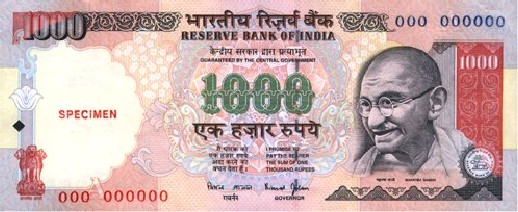
Rs 1000 note costs govt Rs 3.17 to print


It costs money to make money. Last year, the Reserve Bank of India spent Rs 2,376 crore on printing 16.5 billion currency notes of varied denominations and the tab is only set to rise. 

Of all the notes minted, Rs 1,000 costs the least, at Rs 3.17 per note. But the five-rupee note, the smallest in terms of size and denomination, costs the most, 48 paise, compared to the value of the note. 

The number of notes printed has risen consistently. "Inflation remained high, often in double digits, in respect of commodities such as foodgrain, pulses, fruits and vegetables, and milk during 2009-10 and 2010-11 - where transactions are expected to be cash- intensive," the RBI said in its annual report for 2010-11. 


"The size of our currency notes has shrunk over time, probably because of the rising cost of paper. Yet, we maintain different dimensions and colours for different denominations," said Dilip Rajgor, scholar and the author of several books on numismatics. 


Youth tries to hijack train engine for beloved


youth tried to hijack the engine of a train to gift it to his girlfriend on New Year's eve. He was arrested on Friday night at Kursela station and has since been remanded in judicial custody.
The 24-year-old love-struck youth, Ketan Kumar, indulged in the daring act to please his beloved around 8.20pm on Friday. He somehow managed to board the engine of the Katihar-bound 15708 Amrapali Express and whipped out a gun from his pocket, which he held at the temple of the driver. But he was overpowered and arrested by the GRP at Kursela, about 40 km from here.
Katihar SP (railways) Sukan Paswan disclosed that the youth is a student of BBA at Saharsa and a native of Madhepura district.
The identity of the girl could not be established as Kumar refused to disclose her name and place of residence. "Under no circumstance will I disclose my beloved's name," he told newsmen at Katihar.